"Understanding airflow is the first step to creating a uniform climate in poultry houses."
Bram - Aerodynamics Engineer at Vostermans Ventilation
Creating the right climate inside a poultry house is about far more than exchanging air. Birds benefit from an environment where temperature, humidity and air velocity remain as uniform as possible throughout the entire house.
Why is a uniform climate important in a poultry house?
Uneven airflow can lead to temperature gradients, wet litter, dust accumulation, local build-up of CO₂ and ammonia, and bird clustering. These factors directly influence bird welfare, litter quality and overall production performance. For effective air circulation, fan capacity is only one part of the equation. Fan positioning, spacing and interaction between multiple circulation fans all influence the resulting airflow distribution throughout the poultry house.
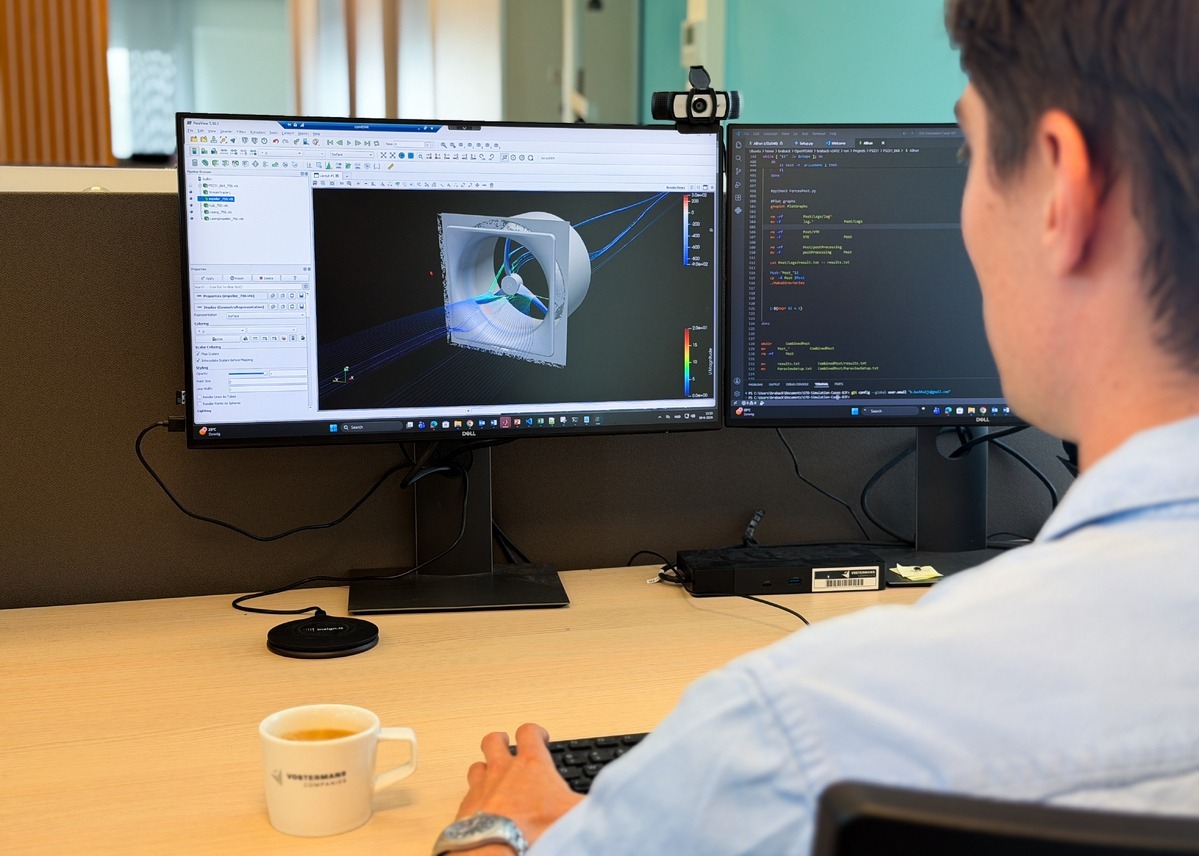
At Vostermans Ventilation, Computational Fluid Dynamics (CFD) is used to study these interactions and to better understand how circulation fans influence overall air movement within poultry houses. By combining aerodynamic expertise with validated simulation models, different circulation concepts can be evaluated before implementation, providing insight into airflow patterns that would otherwise be difficult to measure in practice.
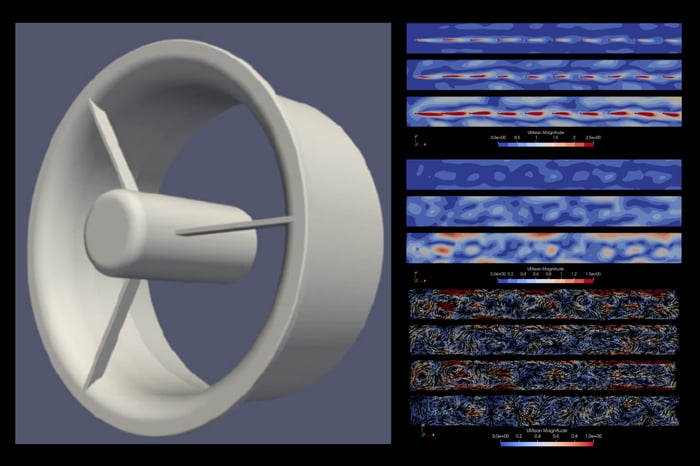
%20(1).png?width=1249&height=395&name=Banner%20Vaca%20Pinta%20180x50%20-%20Multifan%20AirBreeze%20(180%20x%2050%20px)%20(1).png) *Fluid domain discretization around the fan.
*Fluid domain discretization around the fan.
What are the airflow requirements for poultry houses?
Leading industry institutions, such as the University of Georgia (UGA), recommend that an effective circulation system should:
-
Circulate approximately 20% of the total house volume every minute;
-
Maintain an air velocity of approximately 0.5–0.75 m/s at bird level;
-
Minimize areas with little or no air movement and
-
Avoid excessive local air velocities that may create draft.
These criteria form the basis of our CFD analyses and provide objective parameters for comparing different circulation concepts.
A system approach to air circulation
Rather than evaluating individual fans in isolation, our analyses focused on the airflow generated by complete circulation systems within a full-scale poultry house.
The CFD simulations investigated the influence of:
- fan airflow capacity;
- throw distance;
- fan spacing;
- number of circulation fans;
- different installation layouts and
- airflow distribution at bird level.
This system-level approach makes it possible to evaluate not only the performance of individual fans, but also the interaction between multiple fans and the resulting airflow patterns throughout the building.
Key findings
Airflow distribution is influenced by much more than fan capacity alone
For the configurations investigated, distributing airflow over multiple, strategically positioned circulation fans resulted in a more homogeneous climate than concentrating the same airflow into a smaller number of higher-capacity units. This configuration provided a larger area within the target air velocity range (0.5–0.75 m/s) while reducing areas with insufficient air movement. Likewise, layouts in which opposing fan rows blow directly against each other generated internal flow resistance, reducing overall circulation effectiveness. These findings are consistent with published poultry ventilation recommendations and underline the importance of considering the circulation system rather than individual fan performance alone.
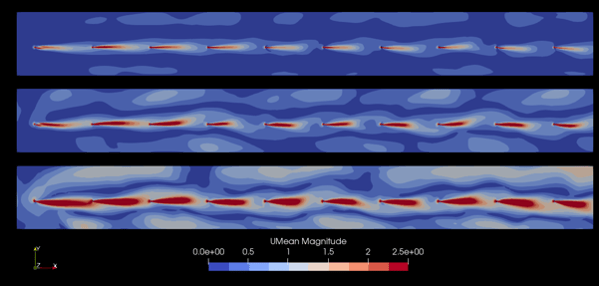
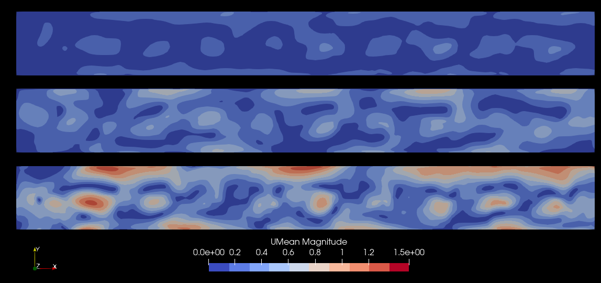
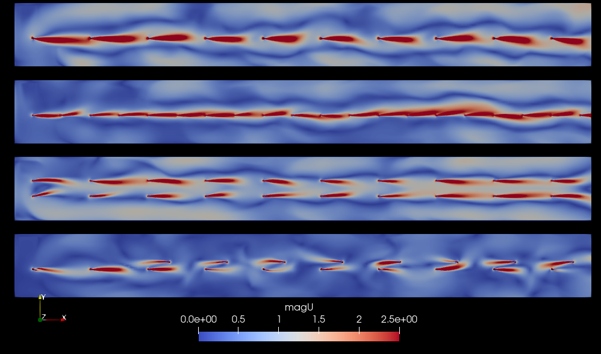 *This overview compares the air velocity distribution at fan level for four air circulation concepts in a poultry house: 10 high-airflow fans, 20 medium-airflow fans, 20 medium-airflow fans in a parallel configuration, and 18 medium-airflow fans in a two-directional configuration.
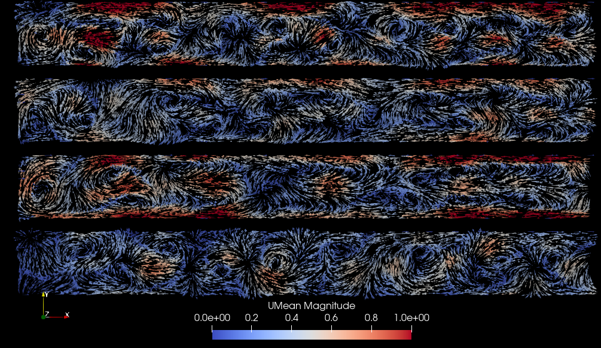 *This overview compares the air velocity and airflow direction at bird level for four air circulation concepts in a poultry house: 10 high-airflow fans, 20 medium-airflow fans, 10 medium-airflow fans in a parallel configuration, and 18 medium-airflow fans in a two-directional configuration.
Using CFD to optimize airflow
CFD simulations provide valuable insight into airflow patterns that cannot easily be observed inside an operating poultry house. Velocity fields, circulation patterns and interaction between fans can be analyzed in detail, making it possible to compare alternative system layouts before installation.
Although practical validation remains an important step, combining numerical simulations with experimental measurements provides a powerful engineering tool for improving circulation concepts and supporting future product development. The methodology also enables optimization for different house dimensions, ventilation strategies and circulation requirements without the need for extensive physical
Conclusion
Effective air circulation is determined by the interaction between fan performance, positioning and system design. CFD analysis shows that achieving a uniform poultry climate requires more than increasing airflow capacity; the distribution of that airflow throughout the building is equally important.
Within the configurations investigated, the most uniform airflow distribution was achieved using two parallel rows of medium-capacity circulation fans. Compared with fewer high-capacity fans, this layout provided a larger area within the target air velocity range while maintaining good overall circulation. Configurations with opposing airflow directions generated internal flow resistance and resulted in a less uniform airflow pattern.
The study demonstrates that optimizing a poultry circulation system is not about maximizing airflow, but about achieving the most uniform airflow distribution throughout the house.
While these findings provide valuable engineering insight, they are based on CFD simulations performed under controlled and idealized conditions. Actual airflow performance may vary depending on factors such as house dimensions, ventilation strategy, equipment layout and operating conditions. Consequently, each poultry house should be evaluated based on its specific design and application.
Discover how Multifan solutions improve poultry house performance. Visit our poultry webpage.